

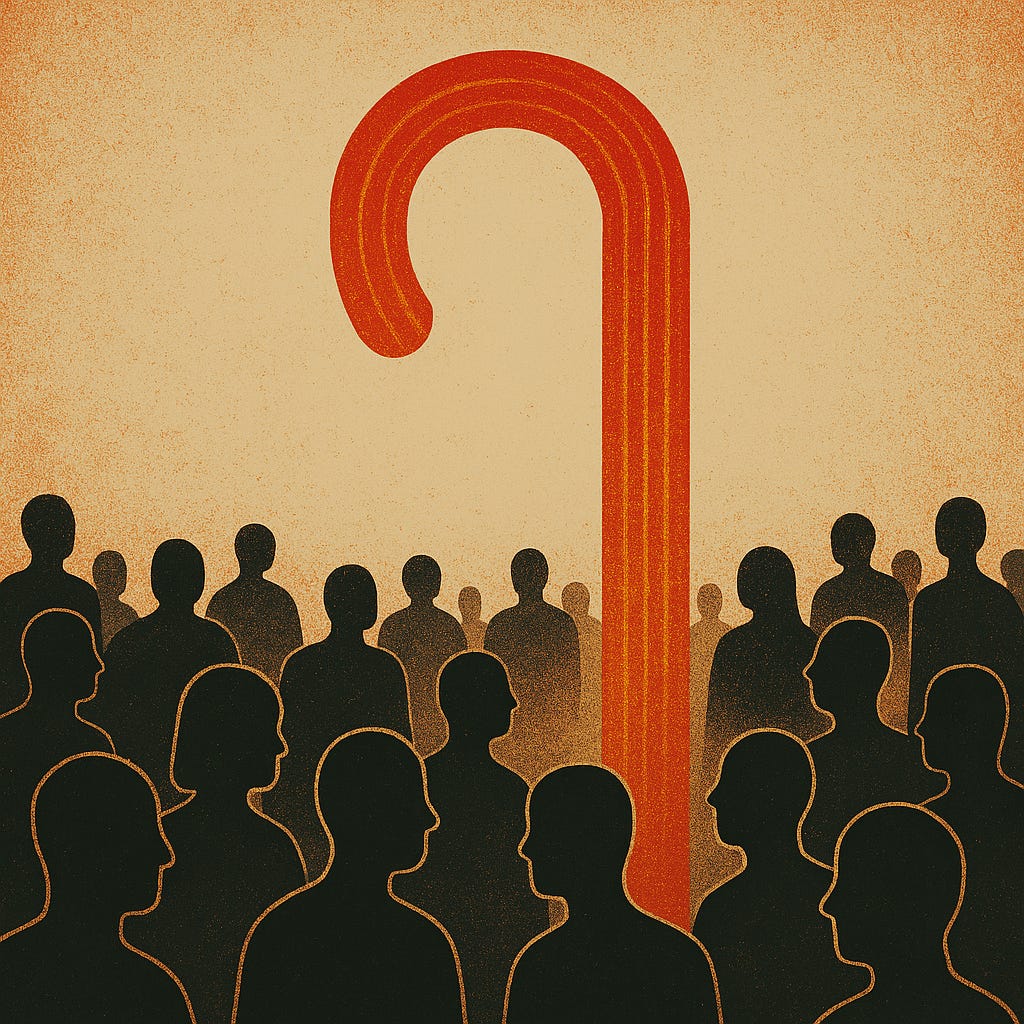
When does motivation at work become manipulation?
At work, we talk about motivation like it’s harmless.
A good thing. A useful thing.
A tool to help people do their best.
We build culture decks. Run team offsites. Share big-picture visions.
We reward “buy-in.” We chase alignment.
And most of the time, it works.
People care more. Try harder. Show up with energy.
Teams move faster. Work feels meaningful.
But here’s the tension:
What if the very things we use to “motivate” people are doing something else, too?
What if we’re not just shaping behaviour…
What if we’re shaping how people think?
And if that’s true, do we really know where the line is?
The brain doesn’t clock off
The brain is adaptable.
It changes based on what it repeats.
Language. Habits. Rewards. Social cues.
They don’t just sit on the surface. They sink in.
So when we build a system full of repeated signals — values, rituals, incentives, praise, pressure — we’re not only guiding performance.
We’re teaching a pattern.
And patterns stick.
That’s why someone starts using company language outside of work.
That’s why they replay conversations in their head after hours.
That’s why “the way we do things here” becomes a lens they see life through.
Not because they’re weak.
Not because they’re broken.
Because the tools worked.
Sometimes they work so well that the system starts travelling home with the person.
And that’s the part we rarely talk about.
Because it doesn’t always look like harm.
It can look like engagement. Like commitment. Like “great culture.”
But that’s exactly why it matters.
A familiar scene
A team returns from an offsite.
They’re charged up. Clear-eyed. Aligned.
There’s energy in the Slack channel. People are optimistic.
Then the weekend arrives.
One person is lying in bed, replaying every message.
Not in a dramatic way. Just… stuck in the rhythm of it.
Their mind still trying to resolve the room.
At dinner, they say:
“That’s not aligned with our values.”
But they’re not talking about work.
They’re talking about a friend. Or a family choice. Or a personal plan.
They aren’t faking it.
They aren’t trying to be “corporate.”
It’s just what’s available in their head, because it’s what’s been reinforced all week.
That’s not motivation anymore.
That’s absorption.
Not always bad.
But worth seeing clearly.
Soft isn’t the same as safe
We call them “soft skills.”
Motivation. Inspiration. Purpose. Vision. Belonging.
But soft doesn’t mean neutral.
When your systems shape how someone processes goals, identity, and decisions — you’re doing more than managing output.
You’re influencing the mind.
And most organisations aren’t treating that influence like a serious design choice.
They treat it like leadership.
Or culture.
Or “getting everyone on the same page.”
But when a tool changes how someone thinks — even outside of work — the ethical stakes change.
Not because anyone intended harm.
Because the impact is deeper than we admit.
The line keeps moving
Here’s the real question:
Where’s the line between support and control?
It’s easy to say:
“Well, people choose to be here.”
And they do.
People have agency. They can leave. They can say no.
But influence can be invisible.
If a system is designed to shape what people want, what they fear, and what they believe is “good” — then choice gets murky.
Not erased.
Just blurred.
Because when the pressure is subtle and constant, you don’t feel forced.
You feel guided.
And if you can’t see the guidance…
it’s harder to tell where you end and the system begins.
This isn’t about blame
None of this means leaders are evil.
Or that culture work is wrong.
Or that motivation is bad.
We’ve used the best tools we had.
Purpose-driven design. Performance frameworks. Culture as a strategic asset.
Offsites. Recognition programs. Incentives. Storytelling.
A lot of it comes from good intent.
But good intent doesn’t make something neutral.
Especially when it changes people in lasting ways.
So maybe this isn’t about blame.
Maybe it’s about responsibility.
If the tools we’ve built are this effective, we need to ask:
What exactly are they changing in people?
And what do we owe people when we use them?
What if the real risk isn’t disengagement?
We worry about quiet quitting.
About people checking out.
But what if the bigger risk is people checking too far in?
Over-identifying. Over-extending.
Shaping their sense of self around what the system rewards.
When that happens, culture fit starts to feel like cognitive fit.
And that’s where autonomy gets blurry.
Because if your brain has been trained to love the system…
you stop noticing it’s there.
You accept it as reality.
You don’t just follow the strategy.
You become it.
That can look like high performance.
But it can also hide a slow loss of self-direction.
And when self-direction drops, decision quality drops with it.
Not immediately.
Over time.
A simple test: support vs control
If you’re using motivation tools — culture, purpose, alignment, incentives — here are four tests that help keep you on the right side of the line.
1) The transparency test
Can we say out loud what we’re doing?
If a tool depends on being invisible, it’s probably not clean.
2) The opt-out test
Can someone step back without social punishment?
If “not joining in” becomes a career risk, motivation has turned into pressure.
3) The boundary test
Does the system ask for contribution — or identity?
It’s one thing to ask people to do excellent work.
It’s another to ask them to be a certain kind of person.
4) The dependency test
Does performance collapse without the emotional push?
If the system needs constant hype to function, it isn’t building capability.
It’s building reliance.
These aren’t perfect.
But they force a useful kind of honesty.
Where do we go from here?
This isn’t a call to scrap the tools.
It’s a call to see them clearly.
Because the moment we shape how people think — even a little — we take on a new kind of responsibility.
Not to stop influencing people.
That’s impossible. Every system influences.
But to influence with care.
To design for autonomy, not just output.
To build motivation that strengthens people, not absorbs them.
And to remember:
When the system gets stronger, the ethical load gets heavier.
So what’s the real question?
Maybe the question isn’t:
“Are we manipulating people?”
Maybe it’s this:
What do we owe people when our tools work this well?
Because if systems shape minds — even in small ways — then strategy becomes ethics.
And ethics becomes design.
We’re not done thinking this through.
The loop stays open.
Because now the system includes the mind.
And if we want workplaces built for the future, we need motivation that doesn’t just move people…
…but keeps them whole while it does.