

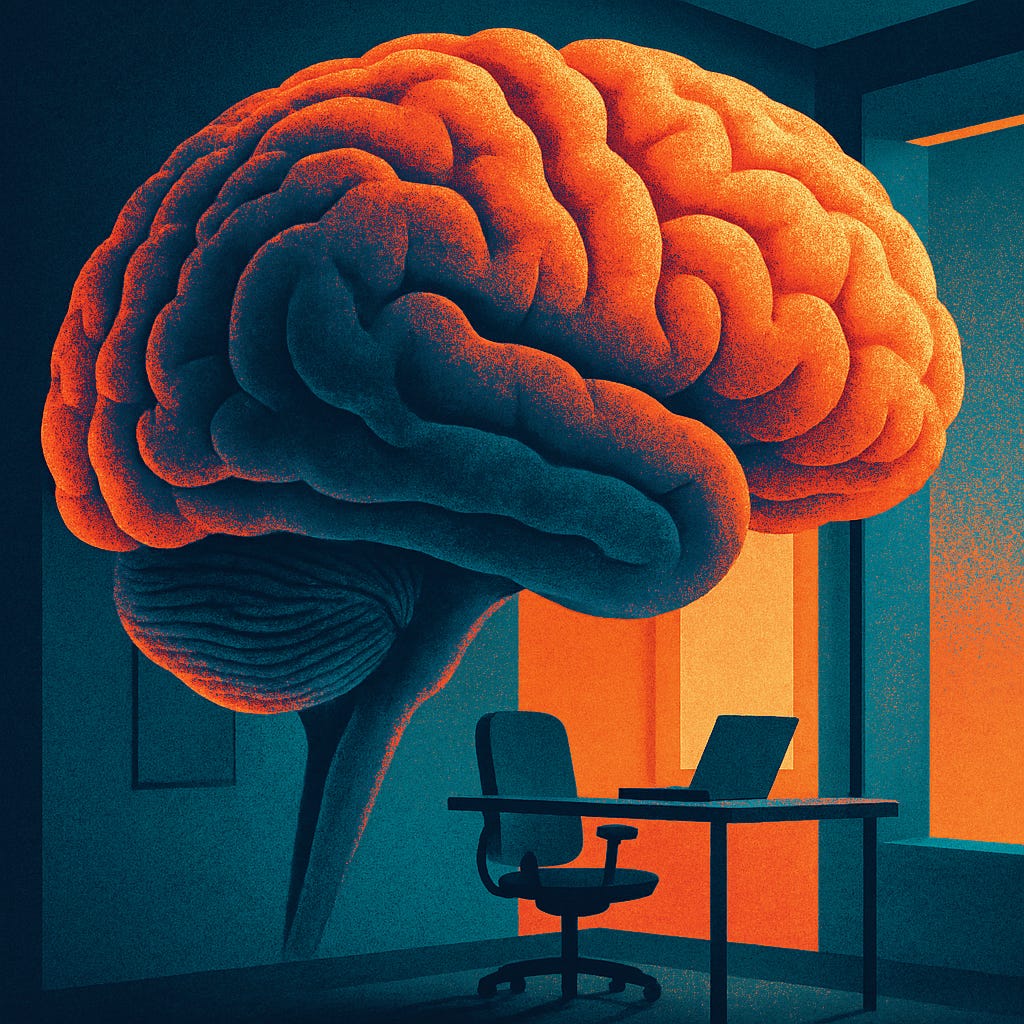
We’ve Optimised Work for Performance — But Forgotten the Body
We’ve spent decades building smarter systems to help people do their best work.
We’ve designed for productivity.
We’ve invested in collaboration.
We’ve obsessed over culture, talent, purpose, motivation.
But in the middle of all that?
We forgot the basics.
We forgot the humans.
We talk about human potential like it’s something inside you.
Your grit. Your mindset. Your ambition.
We act like it’s up to the person to bring their best — no matter where they are, or what they’re surrounded by.
But what if potential isn’t just personal?
What if it’s environmental?
The room is a system — and we’ve been ignoring it
Think about your last workday.
Not the meetings. Not the tasks.
The space.
Was it loud enough to think clearly?
Was the lighting helping you stay alert — or giving you a headache?
Did the layout calm your system… or keep it on edge?
These things seem small. Background. Not strategic.
But they’re not background.
They’re inputs.
The brain doesn’t float in space.
It reacts to sound, light, air, and layout — in real time.
So when we ignore the room, we’re not ignoring comfort.
We’re ignoring cognition.
Brains aren’t just smart — they’re sensitive
Here’s the part that gets missed:
Your brain is a sensor, not just a computer.
It’s constantly scanning for signals.
Noise doesn’t just annoy you — it drains attention.
Harsh lighting doesn’t just look ugly — it can create fatigue.
Stale air doesn’t just feel stuffy — it changes how steady you feel.
No visual boundaries doesn’t just look modern — it can trigger constant scanning.
We know this. We feel it.
But we don’t design for it.
We put people in “high-performance” environments…
and then wonder why no one can focus.
We spend money on culture decks…
then hold team sessions in rooms that feel like interrogation chambers.
We’re solving for performance.
But we’re not designing for the system that powers it.
The science isn’t new — we just didn’t treat it as strategy
There’s a simple idea from performance research that’s been around for a long time:
A little stimulation can help.
Too much stimulation hurts.
In the work context, it shows up like this:
A bit of pressure can sharpen thinking.
Too much pressure, noise, interruption, or sensory load creates fog.
Not because people aren’t capable.
Because the system is flooding them.
So if you’re trying to do deep work in an environment that constantly overstimulates your nervous system…
That’s not a “you” problem.
That’s a design problem.
We’ve been solving for behaviour — not conditions
Here’s where this gets sharp:
We build performance systems.
We hold feedback sessions.
We roll out training and coaching.
All to help people show up better.
But what if they’re already capable…
and just in the wrong environment?
We wouldn’t expect a plant to thrive without light or water.
We wouldn’t expect a sprinter to break records on a broken track.
But we expect high-quality thinking in low-support conditions.
We ask people to:
Be focused in noisy spaces.
Be creative under harsh overhead lights.
Do deep work in open floor plans.
Stay calm in rooms that keep their body slightly braced all day.
Then we wonder why they’re tired, distracted, or not “stepping up.”
But stepping up isn’t the issue.
The conditions are.
The environment is strategy — we just don’t name it
This isn’t about beanbags or “cool offices.”
It’s about seeing space as part of the system.
So here are the questions that matter:
Does the room help the brain stay regulated?
Or does it keep people in reaction mode?
Is the layout reducing noise — or multiplying it?
Are interruptions designed out, or baked in?
Can people access different modes of thinking?
Deep work. Collaboration. Recovery. Creativity. Decision-making.
Or are they stuck in one mode all day: constant response.
The best systems don’t just run well.
They work with how the parts operate.
And if the brain is your most important asset…
Design like it matters.
Because what we call “potential” might not be unrealised at all.
It might just be buried under conditions that drain the system.
A simple 7-day space audit (no big redesign required)
You don’t need a full office rebuild to start.
You just need to pay attention like it’s real.
For one week, ask these five questions — every day:
1) Where does thinking feel easiest?
What time, what spot, what conditions?
If the answer is “at home” or “in the car” or “after everyone leaves,” that’s a signal.
2) What steals attention the most?
Noise? Pings? Walk-bys? Meetings stacked back-to-back?
Name the top two drains. Don’t moralise them. Measure them.
3) Where do people recover?
Not “where do they scroll.”
Where do they reset their nervous system so they can think again?
4) What does the space assume about humans?
Does it assume everyone can focus anywhere, anytime, with no cost?
Does it assume extroversion? Constant availability? Constant visibility?
5) What’s one low-cost change that would reduce load?
Not a renovation. A shift.
One.
Because small changes compound when they remove friction from the brain.
Five low-cost upgrades that unlock capability
If you want a starting list, here are five changes that work in almost any environment:
1) Protect a quiet zone
Even one room, even one corner.
A place where the default is no talk, no calls, no drop-ins.
2) Build “reset” into the day
Default 50-minute meetings.
Add real breaks. Not polite breaks. Real ones.
Because cognition needs recovery to stay sharp.
3) Reduce sensory harshness
If you can’t change the lights, change the choices.
Offer softer options where possible. Let people sit where their brain works best.
4) Create visual boundaries
Open plans often mean constant scanning.
Simple boundaries help: screens, plants, zones, layout rules.
It’s not aesthetics. It’s attention.
5) Treat air and temperature like performance inputs
You track metrics all day.
Track the basics too.
If the room makes people sleepy, you don’t need a motivation talk.
You need better conditions.
We don’t need a redesign — we need a reframe
We don’t need to throw out everything and start from scratch.
Most of what we’ve built works — it got us here.
But it’s time to layer in something else:
sensory intelligence
environmental design that supports cognition
awareness of how space shapes state
Not just hiring smarter.
Not just managing better.
Creating environments where people can think clearly.
Because when the space supports the system…
The system performs better.
Not by squeezing harder.
By draining less.
So here’s the question I can’t shake
What if potential isn’t something you bring with you?
What if it’s something the space either lets you access…
or doesn’t?
And if that’s true…
What does your environment assume about your cognition?
Because potential is real.
And it’s ready.
But maybe the unlock isn’t in the person.
Maybe it’s in the air, the light, the sound, and the space we’ve never quite seen as strategy — until now.