

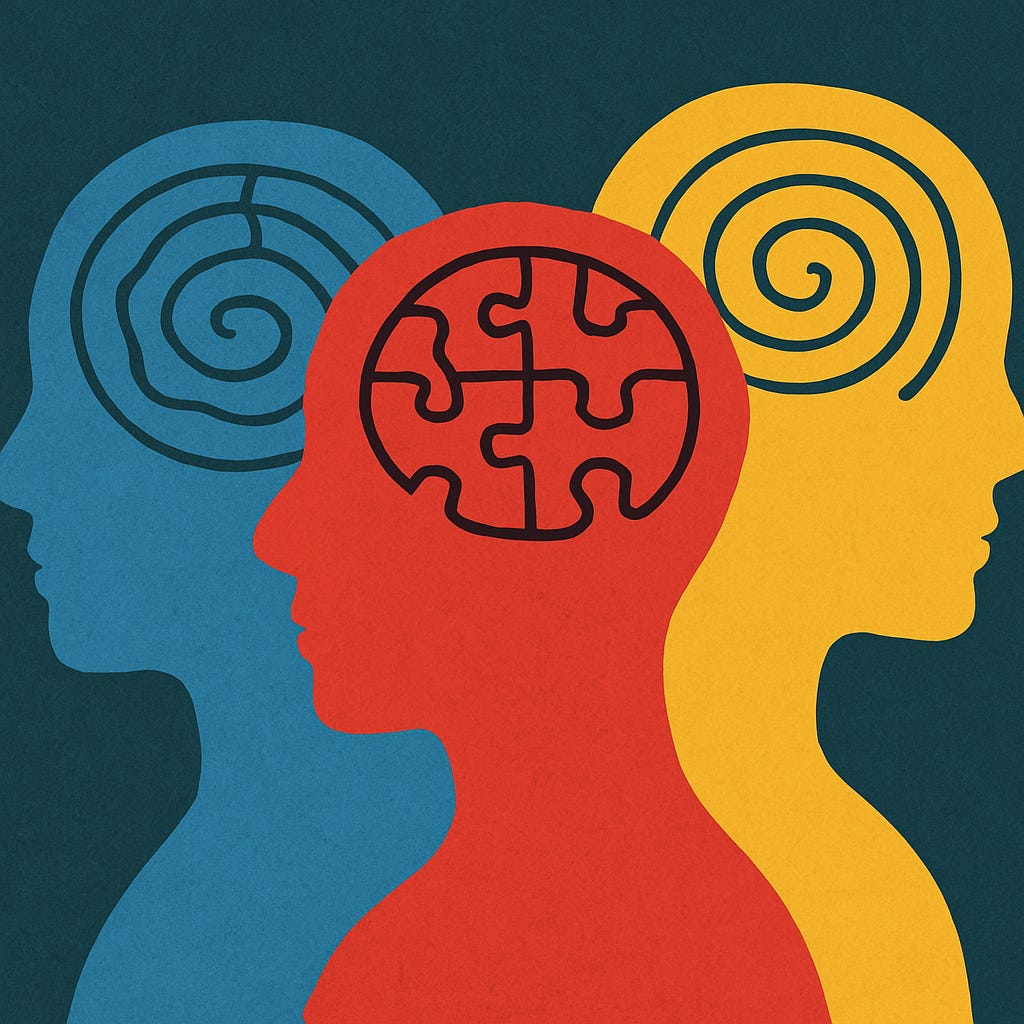
We need to think differently about how we all think differently
Most systems — from hiring to leadership to team design — are built on one quiet idea:
Brains should work the same way.
Fast. Clear. Focused.
Speak up. Stay on task. Follow the plan.
If someone thinks differently, we “make room.”
But usually at the edges. Quietly. Carefully.
Like it’s a favour. Like difference is a problem to manage.
But what if the opposite is true?
What if brain difference isn’t a flaw — it’s a feature?
Not something to include later, but something to build around from the start.
Neurodivergence isn’t rare — difference is normal
We often talk about neurodivergence like it’s a small group over there.
But human brains vary. A lot.
Attention, memory, sensory input, processing speed, pattern recognition — these aren’t the same from person to person. And they aren’t stable within one person across time, either.
Under pressure, those differences get louder.
Some people get sharper.
Some go quiet.
Some need movement to focus.
Some need silence to think.
Some process fast.
Some go deep.
Some need to circle the idea for a while before it clicks.
This isn’t random.
It’s how thinking works.
And it’s everywhere — in every team, in every room, in every strategy meeting you’ve ever been in.
We say we want new thinking — but only if it looks familiar
Here’s the tension.
We say we value innovation, creativity, insight.
We say we want people to think differently.
But when that difference shows up — slow, sharp, quiet, nonlinear — we often miss it.
We praise quick answers over deep ones.
We trust confidence over clarity.
We reward fluency over thoughtfulness.
And the minds that don’t fit that mould?
They get labelled confusing. Or difficult. Or too much.
Not because they’re wrong — but because the system wasn’t built to recognise their signal.
So the signal gets filtered out.
Or people learn to mask.
They shrink. They smooth the edges. They mimic the “right” style — just to survive a system that treats one kind of thinking as normal.
That’s not a personality issue.
That’s design.
This isn’t an HR issue. It’s an intelligence issue.
Inclusion matters. Respect matters. Safety matters.
But this goes beyond values.
This is a capability question.
Because if you only build for brains that perform in familiar ways, you miss everything that doesn’t arrive in the usual shape.
You lose the mind that spots risk early.
You lose the thinker who sees the hidden connection.
You lose the person who can hold complexity without collapsing into simple answers.
You lose the pattern-breaker who could reframe the whole problem.
And you don’t just lose people.
You lose advantage.
The quiet cost: systems that reward performance, not processing
Most workplaces reward:
speed over accuracy
confidence over clarity
polish over truth
sameness over range
So people adapt.
Not toward better thinking — toward safer performance.
And that’s how organisations become “aligned” but less intelligent.
Because alignment is not the same thing as understanding.
A room can look cohesive while the thinking underneath is thin.
People nod because it’s easier.
Not because it’s true.
And when that happens, the system doesn’t just lose disagreement.
It loses the brilliance inside it.
What are we missing?
Ask this honestly:
How many great ideas have been filtered out because they arrived in a different form?
How many insights died in someone’s head because they didn’t have the energy to fight the room?
How many strategic warnings were dismissed because the delivery wasn’t smooth?
How many people learned to shrink, mask, or mimic — just to survive?
This is the hidden cost of designing for sameness:
You don’t just lose inclusion.
You lose range.
And range is what you need when the playbook stops working.
The design shift: build for range
Designing for range doesn’t mean chaos.
It means clarity — the right kind.
Clarity that comes from making space for different processing styles before you decide.
And it starts with one simple move:
Stop confusing thinking with performing.
Most strategy meetings reward performance.
Quick takes. Confident voices. Neat answers.
But the best thinking often shows up differently:
slower
quieter
messier
nonlinear
still forming
If you want that thinking, you have to design for it.
Three practical upgrades (you can use this week)
1) Separate “thinking” from “showing”
Stop asking for instant opinions in public and calling that strategy.
Instead:
ask for written input first (even a messy paragraph)
give time to process
then talk
You don’t lose speed.
You gain signal.
Because people stop performing and start thinking.
2) Create more than one way to contribute
Some people think out loud.
Some people think on the page.
Some need silence first, then they’re sharp.
If your system only rewards one style, you’ll only get one.
So build multiple channels:
async notes before the meeting
silent reading at the start
structured rounds where quieter voices aren’t drowned out
the option to add thoughts after, once the idea has landed
This isn’t accommodation.
It’s intelligence design.
3) Reward signal, not style
Make this explicit:
We value accurate insight, clear trade-offs, and honest risks — even when the delivery is quiet, messy, or non-linear.
Then back it with behaviour:
thank people who name the hard trade-off
protect the person who raises an early risk
slow the room down when confidence shows up without clarity
Because what you reward becomes the system.
The questions that upgrade the room
If you want a team built for range, start asking:
What helps each brain do its best work here?
Where are we confusing speed with competence?
What patterns are we missing because we overvalue polish?
What would change if we designed strategy to expect difference — not erase it?
Because maybe the smartest person in the room isn’t the loudest.
Maybe the best idea didn’t arrive in a straight line.
Maybe the future won’t be built by the most “aligned” team…
…but by the one designed for range.
Where we go next
This isn’t about putting people in boxes.
It’s about breaking the box entirely.
Different brains are not an edge case.
They are the reality of every organisation.
And under load, everyone becomes harder to standardise.
So the question isn’t: “How do we include the different?”
It’s: How do we design systems that expect difference — and use it?
Not how to accommodate neurodivergent thinkers.
But how to build strategy that gets smarter because of them.
Because maybe what we’ve been calling disruption…
…is design intelligence in disguise.