

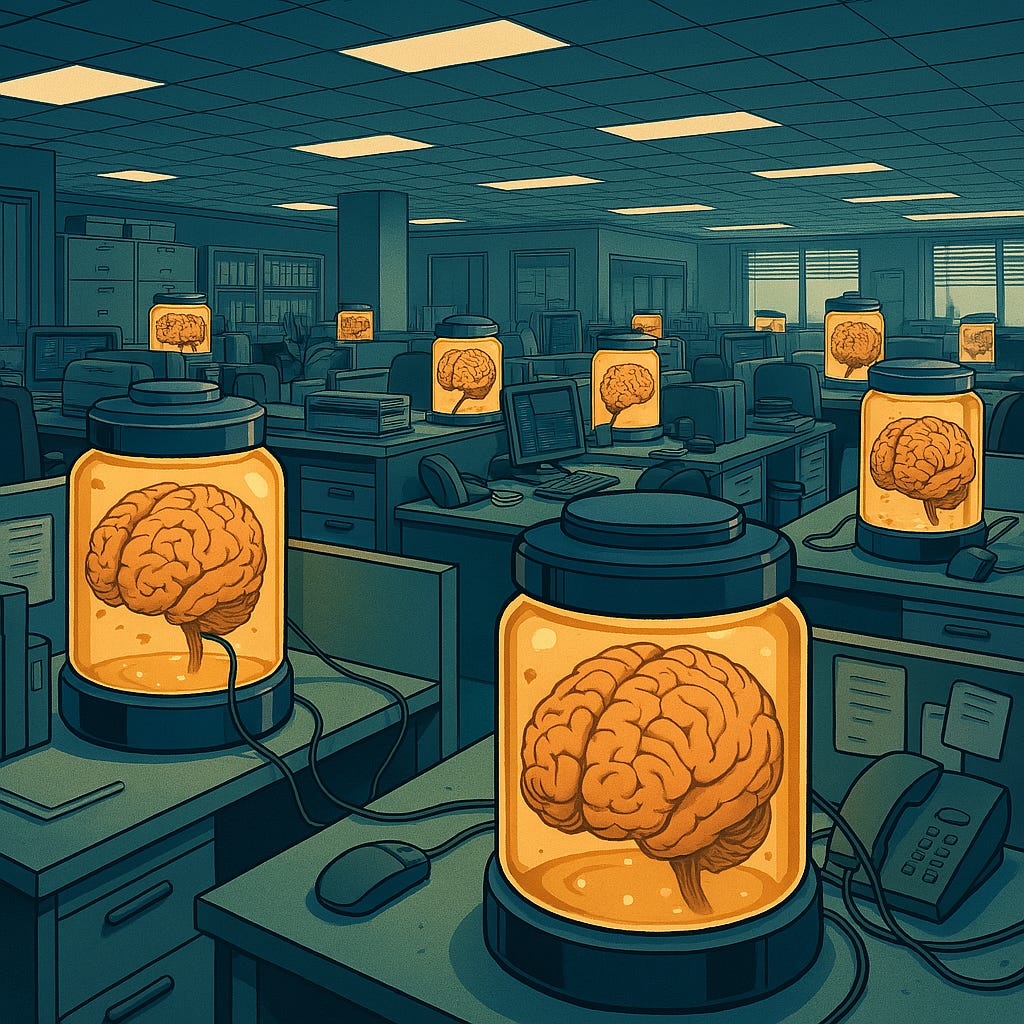
The Signal: Are We Designing Work for Thinking?
Everything we’ve built —
every model, every dashboard, every system —
got us here.
That’s the point.
But something has shifted.
We’ve entered a space where thinking is no longer the tool.
It’s the task.
Not a side effect.
The work.
And once you see that, strategy changes — because the real constraint isn’t time.
It’s bandwidth.
Work as cognitive infrastructure
For decades, we designed work to manage output:
Tasks. Timelines. KPIs. Delivery.
And those tools still matter.
But today, the biggest wins don’t come from squeezing harder. They come from building environments where people can think clearly under pressure — and keep thinking when the load gets heavy.
That’s what I mean by cognitive infrastructure:
The meetings, tools, metrics, and rhythms that shape how people process information — not just what they produce.
Most systems manage behaviour.
But strategy doesn’t live in behaviour.
It lives in how people process.
And human processing is:
emotional
limited
context-sensitive
easily overloaded
So the question gets sharper:
What kind of brain is your work system designed for?
A calm one?
Or a flooded one?
Because most organisations are unintentionally designed for the flooded brain — the brain that’s switching context, scanning threats, trying to keep up, and quietly losing clarity.
And when that happens, decision quality doesn’t dip.
It drops.
A familiar scene: the dashboard that killed the decision
Here’s a pattern I’ve seen across high-performing teams.
A leadership group wants better decisions, so they build more visibility:
More dashboards. More metrics. More weekly updates.
More “alignment.”
The intent is good: reduce uncertainty.
But the effect is the opposite.
The system starts to behave like this:
Meetings get longer, because there’s more to review
Decisions get slower, because there’s more to consider
People stop naming trade-offs, because the room is full of numbers
Nobody wants to be wrong in public, so everyone speaks carefully
You leave with “clarity” — but no movement
It looks mature.
It looks rigorous.
But it’s a subtle failure.
Because information isn’t the same thing as clarity.
And review isn’t the same thing as thinking.
What you’ve built is a high-output reporting machine — in a place that needed a decision-making engine.
And the cost shows up later as:
Rework. Drift. Quiet resentment. Slow execution.
The sense that everyone’s busy, but nothing is clean.
This isn’t a people problem.
It’s design.
We don’t burn out because we’re weak
We burn out because we run out of bandwidth.
Focus fades.
Judgement gets sloppy.
Decisions stall.
Everything fogs — long before the inbox is empty.
And yet most organisations respond to fog with… more input.
More documents. More pre-reads. More dashboards.
More calls for “alignment.”
But overload doesn’t create alignment.
Overload creates compliance.
People nod because they’re tired.
Not because it makes sense.
So if you want strategy that holds under pressure, you don’t just need smart people.
You need a system that protects thinking.
Eight signals your system isn’t built for thinking (yet)
These are not personality issues.
They’re design signals.
If you see them, don’t blame the team. Upgrade the system.
1) Decisions take longer than the work itself
If the decision cycle time keeps expanding, the system is struggling to process reality.
2) Meetings produce summaries, not choices
If the output is “alignment” instead of “we decided X, because of Y,” you’re running a review culture, not a strategy culture.
3) People ask for more data when the real issue is trade-offs
When the room is stuck, it’s usually not because you lack information. It’s because you haven’t named what you’re choosing against.
4) Everyone is “busy,” but priorities don’t bite
If priorities don’t create clear no’s, the system is protecting comfort, not clarity.
5) Rework is normal
If work keeps getting redone, your system is paying a tax for unclear thinking earlier.
6) Interruptions are treated as normal operating conditions
When attention is constantly broken, you’re not designing for thinking — you’re designing for alertness.
7) Slack and dashboards replace conversation
If tools become a substitute for sensemaking, people stop building shared understanding. They start managing perception.
8) The room goes quiet right before commitment
This is a big one.
Silence right before a decision is often not buy-in.
It’s bandwidth collapse.
It’s people thinking: I don’t have the energy to fight this.
The move: design for thinking, not just output
You don’t need “brain data” to do this.
You can read the system through its signals — and redesign the parts that steal cognition.
Here’s a simple, reliable rhythm:
1) Reduce noise on purpose
Before you add a new dashboard, meeting, or metric, ask:
“What will this replace?”
“What will we stop doing?”
“What decision will this make easier — and for who?”
If you can’t answer those, it’s not clarity. It’s clutter.
2) Build a container for real thinking
Most teams don’t need more meetings.
They need one meeting that thinks.
A thinking meeting has a different shape:
one decision per session (not ten topics)
one trade-off named clearly
one owner who must choose
one set of constraints (time, budget, risk)
one test for the next two weeks
That’s strategy you can run.
3) Diverge, then converge — on schedule
Healthy systems don’t force agreement early.
They make space for difference, then bring it back to a choice.
Diverge: “What are two competing ways to see this?”
Sort: “What trade-off are we really making?”
Converge: “What will we do next, and what would change our mind?”
This keeps the system honest without turning every decision into chaos.
4) Measure the right thing
If your measures only track output, people will push output — even when it harms thinking.
Add one simple capability measure:
decision cycle time
rework rate
number of active priorities per team
meeting-to-decision ratio
You’re not measuring people.
You’re measuring whether the system is usable.
This is strategy now
We’re not throwing out the classics.
Structure matters.
Discipline matters.
Rigour matters.
But in a world where work is fast, emotional, and complex, the old quiet assumptions don’t hold:
That people are fully rational.
That more planning always helps.
That more information equals more clarity.
Because the brain doesn’t run on unlimited bandwidth.
So strategy has a new edge:
Design the environment that protects thinking.
Not just output.
Not just behaviour.
Thinking — under load.
Because once you treat thinking like a strategic asset, you stop managing performance like a scoreboard.
And start designing for how performance happens.
And that’s the real signal:
The advantage isn’t in the dashboard.
It’s in the system’s ability to process reality — together — and still move.
So the question to hold is simple:
What kind of thinking are we designing for?
Because the way we design thinking
is the way we shape advantage.
And now that we can see it…
We design forward.