

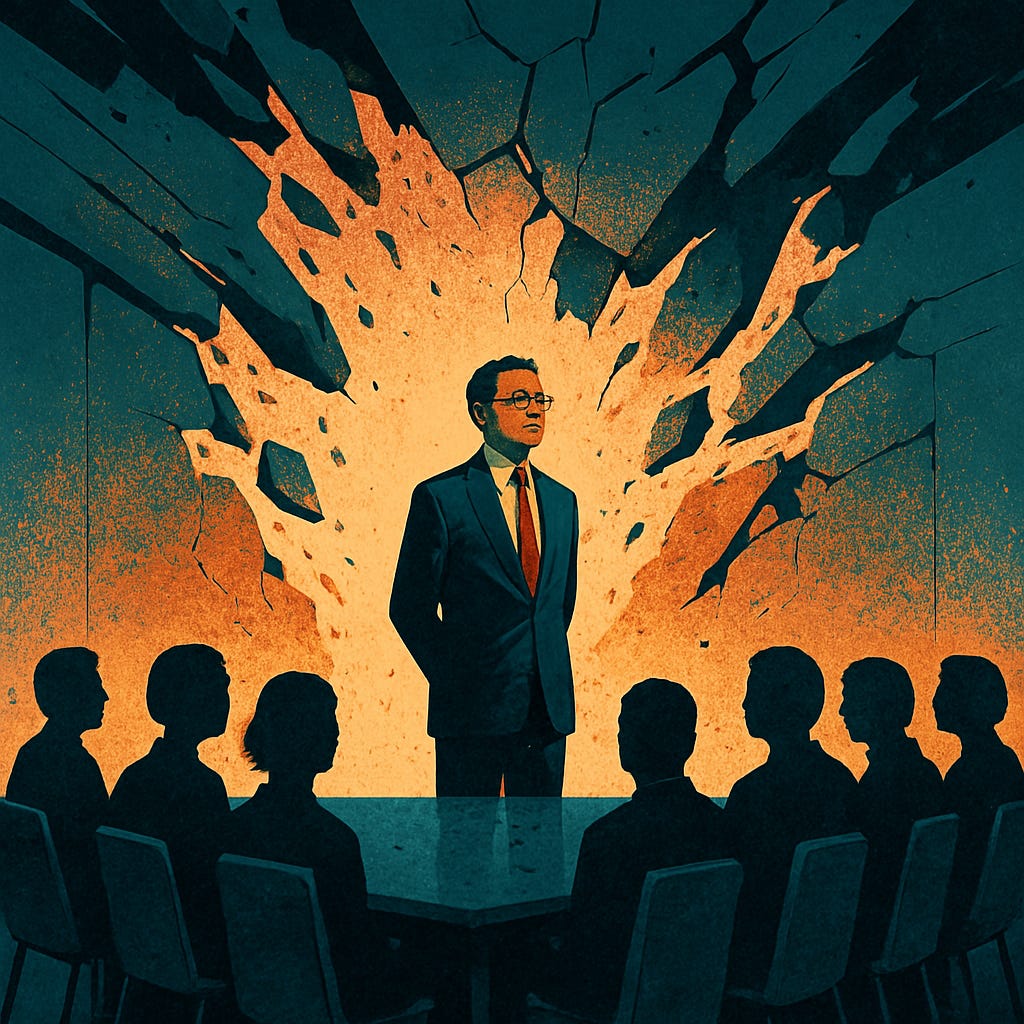
We act like alignment is the gold standard for strategy.
Get everyone on the same page.
Move together.
Agree. Align. Succeed.
Clarity is king.
That’s the rule we’ve been following.
But sometimes that “clarity” isn’t clarity at all.
Sometimes it’s just comfort.
A tidy plan. A clean slide. A room full of nods.
It looks calm. It feels controlled.
And that can be a problem.
Because in complex work — the kind most organisations do now — a perfectly aligned room can be a warning sign.
Not always. But sometimes.
Sometimes it means the system has stopped thinking.
When agreement hides collapse
You’ve been in this meeting.
A strategy session ends. Everyone nods.
Boxes get ticked. Priorities get written down.
On paper, it looks solid.
But something feels off.
People say, “We just need to lean in,” which often really means:
“You need to make a big mental leap to believe this.”
Then two weeks go by… and nothing moves.
Not because people are lazy.
Not because they don’t care.
Because the “agreement” was thin.
The meeting was polite. People spoke in turns.
No one tested the ideas. No one pushed.
No one built on what someone else said.
By the end, the plan looked believable.
But no one believed in it.
It looked like alignment.
It read like progress.
But it was empty.
The room was quiet — not in a focused way.
More like flat.
There might have been hope.
But there wasn’t belief.
And no one wanted to be the person who broke the feeling of unity.
So the illusion stayed.
And the organisation walked out with false alignment.
When alignment becomes inertia
Sometimes a system settles into a pattern that feels smooth — but it’s not working.
Things aren’t falling apart loudly.
They’re just not moving.
It’s a kind of stuckness that can look like success from the outside.
In simple systems, alignment is great.
Safety checks. Manufacturing lines. Clear steps. Clear outcomes.
You want repeatability. You want consistency.
But strategy inside a modern organisation is not a simple system.
It’s people, pressure, trade-offs, shifting goals, and limited attention.
In complex systems, friction isn’t always a failure.
Often, it’s how the system stays alive.
Noise can be data.
Tension can be signal.
It’s how reality gets into the room.
And if we force alignment too early — too cleanly — we shut down the thinking before it has a chance to do its job.
The strategy doesn’t fail because the idea was bad.
It fails because the system didn’t get to breathe.
Misalignment isn’t always a problem to fix
Most leaders are trained to treat misalignment like a fault.
A communication problem.
A buy-in problem.
A “get people on board” problem.
Sometimes that’s true.
But sometimes misalignment is something else.
Sometimes it’s the system saying:
“Hey — this part doesn’t make sense yet.”
It’s the organisation trying to tell the truth while it still can.
And if we treat that signal like noise — if we rush to smooth it out — we don’t just lose disagreement.
We lose the intelligence inside it.
The goal isn’t to create conflict.
The goal is to keep the system capable.
Capable means: we can see what’s real, talk about it, and adapt without falling apart.
False alignment makes an organisation look calm while it slowly loses that ability.
A simple test: healthy friction vs false alignment
Here’s a quick way to spot what’s happening in the room.
You’re seeing healthy friction when:
People disagree and build on each other.
Questions get sharper over time.
The team names real trade-offs.
The energy is honest, not performative.
That’s thinking. That’s capability.
You’re seeing false alignment when:
The room is quiet, but not clear.
People nod, but no one tests the logic.
Everyone sounds the same.
After the meeting, nothing actually changes.
That’s not unity. That’s drift.
You’re seeing stuck conflict when:
The room is loud, but positions don’t move.
The same arguments repeat.
People defend identity instead of exploring reality.
That’s not “needs more alignment.”
That needs a better container.
The move: diverge on purpose, converge on schedule
If you want strategy without the fake calm, use a simple rhythm:
1) Diverge on purpose
Make room for difference early.
Ask:
“What are three different stories about what’s happening right now?”
“What does success look like — and what might it cost?”
“What are we pretending is true because it feels easier?”
You’re not trying to create chaos.
You’re letting reality show up.
2) Metabolise the friction
Don’t rush to agreement. Sort the signal.
Name the trade-offs out loud:
“If we choose A, what do we give up?”
“What are we optimising for?”
“Where are we guessing?”
This is where capability gets built — in the open.
3) Converge with a real decision
Alignment is useful after thinking.
But don’t converge into a slide deck.
Converge into a test.
Decide:
What will we try in the next two weeks?
What will we measure?
What would make us change our mind?
That turns strategy into motion.
So… does chaos belong in strategy?
If by chaos you mean confusion, drama, or endless debate — no.
But if by chaos you mean space for honest friction — then yes.
Not because alignment is bad.
Because alignment without thinking is dangerous.
It makes the organisation look coordinated while it quietly loses its ability to adapt.
The goal isn’t to keep everyone comfortable.
The goal is to keep the system capable.
Sometimes the fastest path to real clarity is letting things be a little messy first — so you can sort what’s true.
So maybe the real question isn’t: “Should we have alignment?”
It’s: When are we trying to align too early?
Because sometimes what looks like chaos is just the system doing what it’s supposed to do:
Thinking out loud — before it commits.