

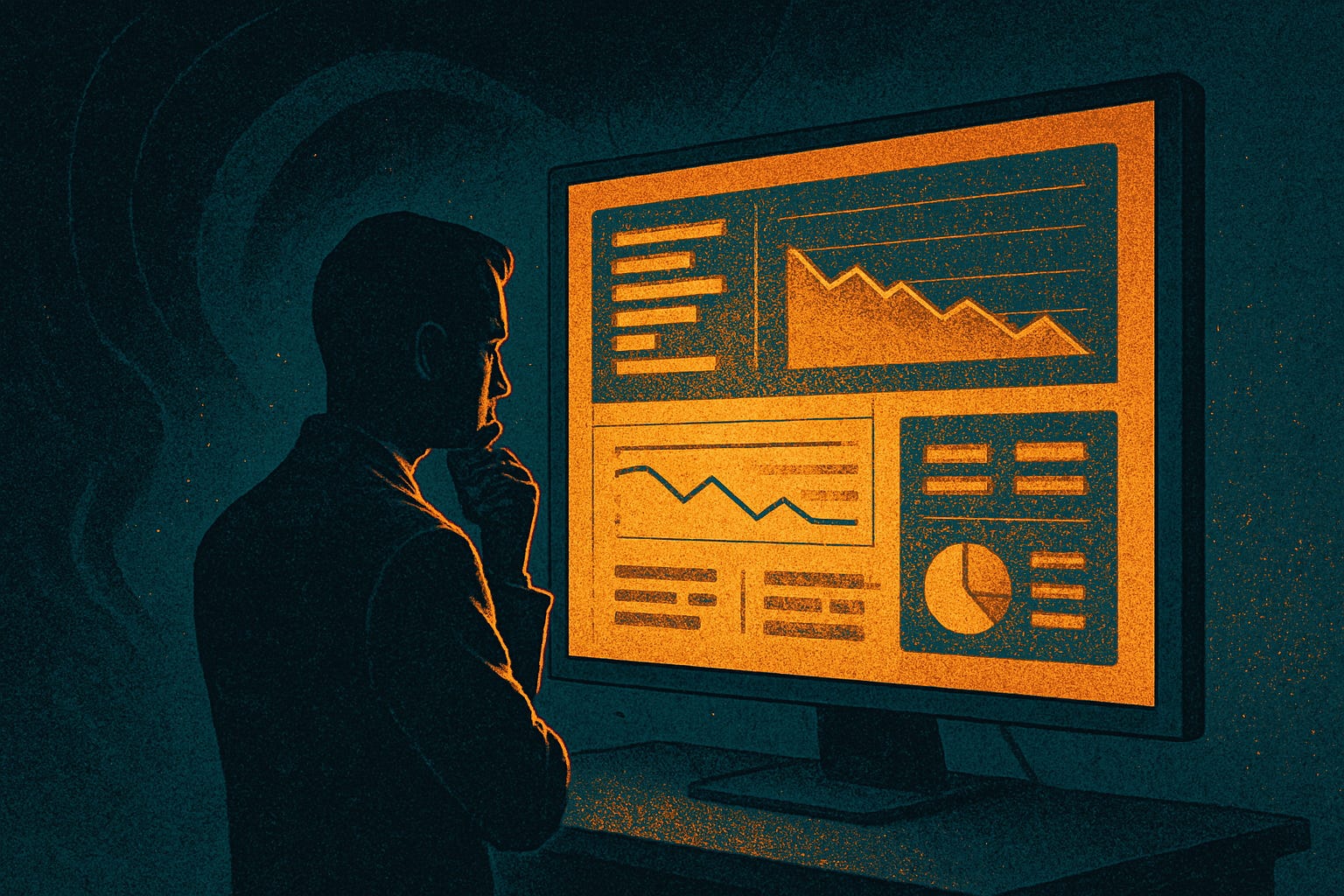
Are dashboards helping us think — or just giving us an excuse to think less?
Somewhere along the way, strategy stopped being a question…
and became a screen.
Dashboards. Metrics. Heatmaps. Scorecards.
We build them. Refresh them. Bring them into every meeting.
And the quiet assumption is:
If we can see it, we can solve it.
Visibility equals control.
Measurement equals insight.
And strategy? That’s whatever shows up in the data.
But what if that logic is off?
What if the tools we built to help us lead are also training us not to think?
The data looks good. But something’s off.
You know this room.
The team is there.
The dashboard is up.
Most things are green.
But the questions feel flat.
No one’s naming what doesn’t make sense.
No one’s testing the story.
No one’s saying the thing they can feel but can’t prove.
Because we don’t really know what all the green means.
And when a KPI dips, the reflex is immediate:
“Let’s pull more data.”
But more data doesn’t always mean more insight.
And staring at a dashboard isn’t the same as seeing what matters.
So what are we actually doing?
When the tool starts thinking for you
There’s a term for this: cognitive offloading.
It’s when we shift mental work onto something outside ourselves — a calculator, a checklist, a map.
Most of the time, it’s helpful.
It frees up space.
But here’s the catch:
If we offload too much, we can stop practicing the muscle.
Dashboards were meant to support thinking.
Instead, they can become a shortcut around it.
We don’t wrestle with uncertainty.
We wait for the red light.
We let the screen tell us what matters — and then call it foresight.
But real foresight doesn’t come from staring at a chart.
It comes from how we think when the chart goes blank.
The cost we’re not naming
We’re losing something — and it’s not just attention span.
It’s strategic depth.
It’s the ability to notice weak signals before the evidence arrives.
It’s the skill of sitting with uncertainty and still making sense.
When everything gets filtered through dashboards, we start thinking like dashboards:
Binary. Reactive. Surface-deep. After the fact.
And the irony?
We built these tools to help us lead.
But leadership isn’t clicking through KPIs.
It’s making judgement calls when there is no data — just tension.
The blind spot hiding in plain sight
Here’s what’s easy to miss:
The more we rely on dashboards to tell us what’s happening…
the less we ask why.
And the less we ask why, the more we start trusting the tool too much — even when it’s incomplete.
The dashboard says green?
We move on.
Even if something in the room still feels off.
No one says it out loud — because the numbers look fine.
So we start mistaking what’s visible for what’s real.
And that’s when real thinking gets flattened.
Not by bad intent.
By design.
Dashboards aren’t the enemy. But they aren’t neutral.
Let’s be clear: dashboards can be useful.
They’re not the problem.
The problem is what happens when the dashboard becomes the strategy.
When the numbers replace the conversation.
When review replaces judgement.
When “tracking” becomes an excuse not to think.
Because thinking is messy.
It doesn’t always fit inside a tidy column or a colour code.
So maybe the real question is:
Are we using dashboards to clarify strategy…
or to avoid the discomfort of judgement?
Because if all we’re doing is reacting to numbers, we’re not leading.
We’re executing whatever the system tells us is urgent.
The dashboard reset (a practical way to keep your brain switched on)
If you want dashboards that support thinking — not replace it — try this simple reset.
Before you open the dashboard in a meeting, ask these five questions:
1) What decision are we here to make?
If there’s no decision, don’t pretend it’s strategy.
It’s reporting. Name it.
2) What do we believe is happening — before we look?
Write a one-sentence hypothesis.
Not because you want to be right.
Because you want to notice what surprises you.
3) What would this dashboard never show us?
What’s missing by default?
Customer emotion. Team fatigue. Workarounds. Quiet risk.
The things that matter often live off-screen.
4) What’s the smallest number of metrics we need to see?
If you need thirty metrics to make one decision, you don’t have clarity.
You have noise.
5) What are we going to do with what we see?
If the answer is “keep watching,” you’re not thinking — you’re monitoring.
Dashboards should end in a choice.
Or they should end in a better question.
Build dashboards that amplify thinking
If you’re designing dashboards, a few rules help keep them honest:
Show trend, not just status. Green today can still be drift.
Add context, not just numbers. One line of “why” beats ten charts.
Make uncertainty visible. If the data is incomplete, say it.
Design for questions. A good dashboard creates inquiry, not closure.
Because the goal isn’t control.
The goal is sensemaking.
This isn’t about data. It’s about design.
To really understand what’s going on here, we have to zoom out.
This isn’t a tech problem.
It’s a thinking problem.
It’s a design problem.
It’s a foresight problem.
We’re not just building dashboards.
We’re building cognitive environments — places where decisions get made, pressure gets processed, and direction gets set.
And if those environments reward looking instead of thinking…
we shouldn’t be surprised when judgement gets replaced by a feed.
So what are dashboards really doing to us?
This isn’t a rejection of data.
It’s a reminder:
Data isn’t the answer.
It helps us ask better questions.
But only if we keep the human part switched on.
So the question still stands:
Are dashboards helping us think —
or just giving us an excuse to think less?
That’s the tension.
Not a problem to “fix” overnight — a pattern to notice.
You’ve felt it.
You’ve seen it.
Maybe you’ve lived inside it.
So let’s stay with it.
Let’s follow the friction.
Because what’s being shaped isn’t just our tools.
It’s us.
And the way we think now shapes how we lead next.